How and where physical gold and silver is stored inside a self-managed superannuation fund is one of the most heavily scrutinised areas in an SMSF audit. The rules are clear on paper but applied with judgement, and what feels intuitive to a private investor — keeping precious metals at home, in a safe — is often the wrong answer when the metal is owned by a super fund. This article sets out the storage framework, the practical options, and what auditors typically look for.
The two regulatory layers
Two layers of rules govern SMSF storage. The first is the sole purpose test in section 62 of the Superannuation Industry (Supervision) Act 1993, which requires every fund asset to be maintained solely for the purpose of providing retirement benefits to members. The second is Regulation 13.18AA of the Superannuation Industry (Supervision) Regulations 1994, which imposes specific storage restrictions on assets classified as “collectables and personal-use assets”.
The two layers interact in a way that catches many trustees off guard. Investment-grade bullion is generally not classified as a collectable, so Regulation 13.18AA does not strictly prohibit storing it at a member’s residence. However, the sole purpose test still applies, and storing bullion at home creates a perception — and often a reality — that the asset could be accessed, used or enjoyed by a member, which can be construed as a sole purpose breach. The practical position adopted by the ATO and by most SMSF auditors is that independent vault storage is the safer and strongly preferred option for all SMSF bullion.
Where collectables sit
If a precious metal product is classified as a collectable — for example, a numismatic coin, a proof coin, a piece of gold jewellery, or a coin valued for rarity rather than metal content — the rules are stricter. Regulation 13.18AA explicitly prohibits storage of an SMSF-owned collectable at the private residence of any related party. “Related party” is a broad concept that includes members, their relatives, and entities they control. A collectable can be stored in a commercial premises owned by a related party but only if it is not on display, the storage decision is documented in writing, and the documentation is retained for at least 10 years.
In addition, an SMSF-owned collectable must be insured in the name of the trustees within seven days of acquisition. The seven-day rule is strict and missed deadlines have been the subject of contravention reports.
Storage options for SMSF bullion
Several storage models are commonly used by SMSF trustees. Here are the five most common storage options:
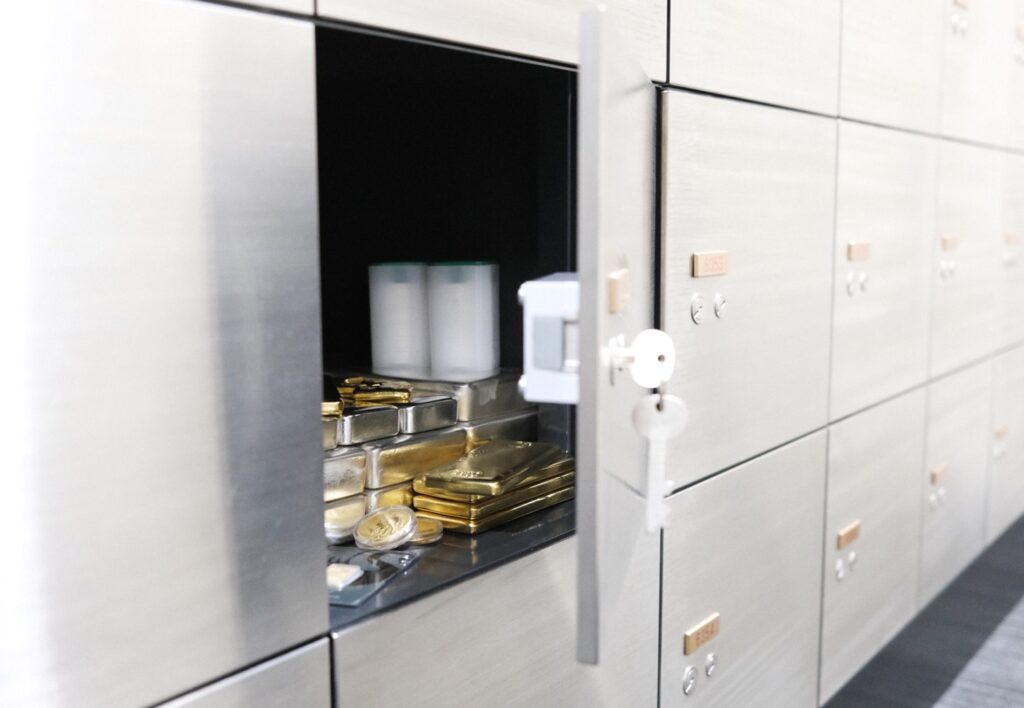
- Safe deposit box at an independent facility. This is generally regarded as the gold standard for SMSF storage. A safe deposit box leased in the name of the SMSF at a secure facility provides allocated storage for trustees who want to be able to access their metals directly. Where this arrangement is used, the box should contain only SMSF assets — mixing personal bullion or SMSF documents with the fund’s holdings creates sole purpose test risk. Many trustees who hold bullion both personally and through their fund lease two boxes, one for each. Safe deposit box storage such as Guardian Vaults is often preffered by SMSF trustees, as it allows both physical control of the assets to sit with the trustee, but has a fixed annual fee and easy audit process at end of financial year.
- Allocated storage in an independent vault. Specific bars and coins are identified as belonging to the SMSF and stored in a vault operated by an independent provider. The storage agreement is in the name of the fund. The provider issues an annual inventory statement that the auditor can verify. The trustees can sometimes inspect their holdings by appointment, depending on the provider. Fees are usually variable and charged as a percentage of value.
- Pooled or unallocated storage. Some providers offer arrangements where the SMSF holds a claim on a quantity of metal rather than specific bars. This is generally cheaper but is less audit-friendly because there are no specific items to verify. Some auditors are prepared to accept unallocated storage backed by a credible custodian; others prefer allocated arrangements.
- Storage at a refinery’s depository. The Perth Mint, for example, offers depository services that are used by SMSFs. Depository options often charge a storage fee as a percentage of the value of the metal, which means your storage fees can rise with the appreciation of the underlying value of your holding.
Storage at a member’s home is, as noted, technically permitted for investment-grade bullion but is widely viewed as poor practice and creates avoidable audit risk.

Insurance
Insurance for SMSF-held bullion is not specifically mandated by the SIS Regulations in the way it is for collectables. However, Regulation 4.09 requires the trustees’ investment strategy to consider insurance, and where bullion represents a significant portion of fund assets, an auditor may recommend insurance in the fund’s best interests. Where bullion is stored with a vault provider, insurance is usually built into the service. Where bullion is stored elsewhere, separate cover should be considered and documented.
Documentation the auditor will want to see
Each year, the SMSF auditor will review the fund’s storage arrangements and look for several items of evidence:
- Purchase invoices clearly identifying the SMSF as the buyer
- A storage agreement in the name of the fund
- An inventory statement issued by the storage provider at or near 30 June, listing the holdings and confirming the SMSF’s ownership
- Photographic evidence of the holdings, where available, particularly for higher-value funds
- Annual valuations supported by current spot prices and the relevant weights
- Evidence of insurance where applicable
- A current investment strategy that references bullion and considers diversification, liquidity and risk
Auditors will also look for any indication that storage arrangements may have changed during the year, that bullion has been physically inspected or handled by members, or that fund and personal holdings have been mixed.
Related-party storage providers
A subtle but important issue arises where the storage provider is a related party of the fund. For example, if a member of the SMSF is also a director of the vault company, storage charges paid by the fund to the vault would need to be on arm’s-length terms to avoid non-arm’s length expenditure rules. The non-arm’s length income provisions in the tax law can impose tax of up to 45 per cent on income tainted by non-arm’s length dealings. Trustees in this position should obtain advice before entering into a storage arrangement with a related provider.
Practical pitfalls
The mistakes that auditors flag most often in this area are surprisingly consistent year after year. Common issues include storage agreements in a member’s name rather than the fund’s name, safe deposit boxes containing a mixture of SMSF and personal assets, the absence of an inventory statement at 30 June, valuations using a stale spot price, bullion that has been moved from vault storage to home storage without the investment strategy being updated, and insurance arrangements that have lapsed.
Each of these is straightforward to fix if caught early, and most are caught by a competent auditor before they reach the level of a reportable contravention. The trustees’ responsibility, though, is to ensure the arrangements are set up correctly from the start.
Closing note
The storage rules for SMSF-held precious metals are not complicated, but they are unforgiving. Independent allocated vault storage in the name of the fund, with proper documentation and an annual inventory statement, addresses almost every issue that an auditor will look for. The information in this article is general only and does not consider any particular fund’s circumstances. Trustees who are setting up new storage arrangements, or revisiting existing ones, should obtain advice from a qualified SMSF professional.
More information on bullion storage prices can be found below:
By Guardian Gold Australia
Guardian Gold Australia is a leading bullion trading company and is part of Australia’s largest private vaulting group- Guardian Vaults.
To follow our market commentary and more, create a free trading account online HERE.
Follow Us On Socials


Disclaimers: Guardian Gold, Registered Office, Scottish House, 100 William Street, Melbourne, Victoria, 3000. ACN 138618176 (“Guardian Vaults” & “Guardian Gold”) All rights reserved. Any reproduction, copying, or redistribution, in whole or in part, is prohibited without written permission from the publisher and/or the author. Information contained herein is believed to be reliable, but its accuracy cannot be guaranteed. It is not designed to meet your personal situation.
Guardian Gold, its officers, agents, representatives and employees do not hold an Australian Financial Services License (AFSL), are not an authorised representative of an AFSL and otherwise are not qualified to provide you with advice of any kind in relation to financial products. If you require advice about a financial product, you should contact a properly licensed or authorised financial advisor.
The information is indicative and general in nature only and is prepared for information purposes only and does not purport to contain all matters relevant to any particular investment. Subject to any terms implied by law and which cannot be excluded, Guardian Gold, shall not be liable for any errors, omissions, defects or misrepresentations (including by reasons of negligence, negligent misstatement or otherwise) or for any loss or damage (direct or indirect) suffered by persons who use or rely on such information.
The opinions expressed herein are those of the publisher and/or the author and may not be representative of the opinions of Guardian Gold, its officers, agents, representatives and employees. Such information does not take into account the particular circumstances, investment objectives and needs for investment of any person, or purport to be comprehensive or constitute investment or financial product advice and should not be relied upon as such.
Past performance is not indicative of future results. Due to various factors, including changing market conditions and/or laws the content may no longer be reflective of current opinions or positions. You should seek professional advice before you decide to invest or consider any action based on the information provided. If you do not agree with any of the above disclaimers, you should immediately cease viewing or making use of any of the information provided.